Role Product Strategy Research · Market Research · User Insight Analysis
Industry Future of Work / Talent Marketplace
Timeline Research Sprint

Droomwork

Product strategy research that uncovered a deeper market problem:
digital hiring is constrained less by talent scarcity and more by trust friction.

Droomwork sought to realign its product strategy with actual market behavior.

Initial assumptions framed the opportunity as a talent supply problem. Research revealed a more important constraint: trust, validation, and hiring confidence are the real market bottlenecks.

The Challenge

Digital hiring environments often assume that connecting talent to opportunity is primarily a discovery challenge.

But for emerging talents, startups, and recruiters, the real friction begins earlier: Who can be trusted? How can credibility be assessed quickly? How can hiring risk be reduced without expensive or rigid vetting?

Droomwork needed to understand whether the opportunity was truly marketplace inefficiency — or something deeper.

Key Business Questions
  • Why do clients hesitate before hiring unknown talent?
  • How do emerging talents prove credibility?
  • What signals reduce uncertainty fastest?
  • What product direction best aligns with real user behavior?

Research Scope

The study explored behavioral patterns across digital freelancing, sourcing, vetting, and project decision-making.

What We Studied
  • Talent sourcing behavior
  • Vetting and credibility patterns
  • Client hiring criteria
  • Communication behavior before project initiation
Research Hypothesis

Assumption
The market gap is not only a talent-supply problem. It is fundamentally a credibility problem.

Clients struggle to know who to trust. Emerging talents struggle to prove readiness.

Key Insights

Three recurring behavioral patterns shaped the strategic direction.

01

Trust is outsourced to referrals. Referrals repeatedly replaced formal vetting, especially among startups and non-corporate clients. When trust already exists socially, decision friction reduces dramatically.

02

Communication is the first hiring filter. Clients evaluate responsiveness, communication clarity, and collaboration ease before technical output. Hiring decisions begin with perceived ease of working together.

03

Proof drives decisions, not promises. Portfolio quality, experience visibility, timelines, and prior outcomes consistently shaped hiring confidence. Users want visible reliability signals.

Strategic Synthesis

The research reframed Droomwork's opportunity.

The business was not building another generic talent marketplace. It was positioned to create a trust-native infrastructure for digital hiring.

What Changed
✕

Talent marketplace

→
✓

Trust and validation system

Recommended Product Direction

Three product pillars to build a trust-native hiring ecosystem.

Pillar 01

Referral-Based Discovery

Design discovery around real-world recommendation behavior. Help users discover trusted talent through visible referrals and network recommendations.

Pillar 02

Lightweight Skill Verification

Allow users to validate readiness through simple communication, technical, and soft-skill assessments.

Pillar 03

Portable Trust Signals

Make credibility visible and transferable across profiles — referral history, portfolio proof, collaboration records, and communication readiness.

Product Experience

The proposed system reduces uncertainty for both sides of the hiring marketplace.

Suggested Visuals
  • Hiring flow diagram
  • Trust ecosystem map
  • Marketplace wireframes
  • Referral system concept
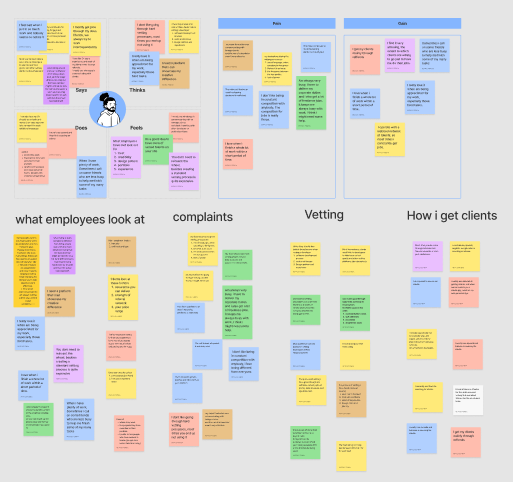
Droomwork Stickynotes Visuals — Research and synthesis
01 Research Synthesis
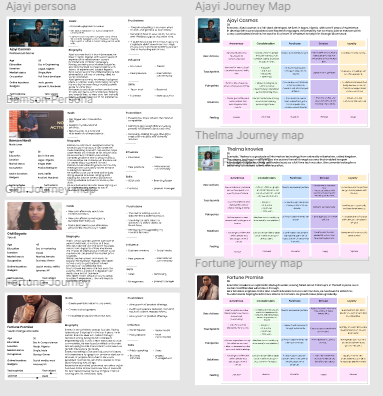
Droomwork Persona Visuals — Understanding the target users
02 User Personas
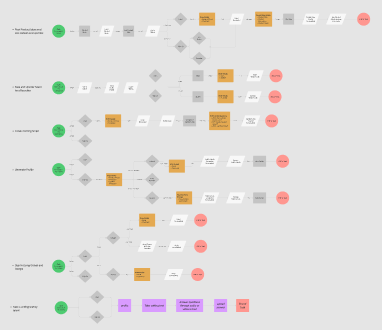
Droomwork Flows Visuals — Hiring ecosystem and user journeys
03 Ecosystem Flows

Expected Impact

Reduced hiring uncertainty

Faster trust formation

Better discovery for emerging talent

Stronger product differentiation in crowded marketplaces

Key Learnings

Markets often disguise their real constraints.

What appears to be a supply problem is sometimes a confidence problem. Product strategy becomes stronger when teams stop optimizing for assumed behavior and start designing around real decision patterns.

View Live Project
Explore More Work

Let's build
something
valuable.

Have a project in mind? I bring strategic research and service design into your next initiative. Let's have a conversation about what's possible.

Start a Conversation